By Dominique Gilbert, Christina Gold, Zachary Greening, Noa Hechtman, Jacob Wolfe
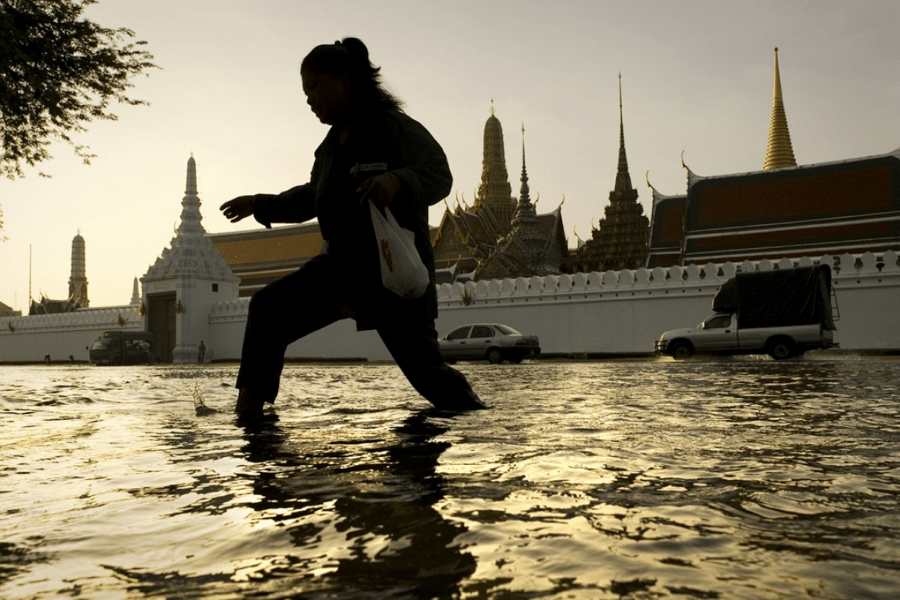
Flooding in Bangkok (Source: South China Morning Post)
When I first heard about the sinking cities it was from one of the servers I work with. She is originally from Bangkok, the capital of Thailand. Bangkok is just one of the many urban areas in the world that has been affected by climate change. “As temperatures rise, abnormal weather patterns – like more powerful cyclones, erratic rainfall, and intense droughts and floods – are predicted to worsen over time, adding pressure on governments tasked with bringing the 2015 Paris climate treaty to life (South China Morning Post)”. She told me that they are considering moving the capital to a different city due to all the smog, overcrowding, and the fact that the city is sinking. I could not believe that a country could move its capital. Think of all the businesses that would have to move. Think about all the people who work at the capital. They would either have to commute to the new capital, wherever that ended up being, or move to the new capital. If they moved to the new capital location, think about their families. Their families would relocate with them. They would have to uproot their entire life. Their family members would have to get new jobs or transfer to a different location if possible. They would also have to figure their housing situation. Think about all the culture that will be lost. I could not image having to go through all that. I looked into the issue more and realized why the government would even suggest moving the capital, Bangkok.
Bangkok is another one of the cities that has been affected. Bangkok was originally built 5 feet above sea level on what was once-marshy land full with mangroves. Now Bangkok has eroding shorelines, the weight of countless skyscrapers, and no natural drainage system. Where canals once were now lays roadways. The mangroves are practically non existent now due to the take over of aquaculture development. Mangroves are nature’s way of preventing erosion and reducing storm surge. “Seas in the nearby Gulf of Thailand are rising by four millimeters a year, above the global average (South China Morning Post)”. Basically, the weight of the city is causing Bangkok to be pushed down do to the overpopulation and the weight the skyscrapers. At the same time, due to climate change, the sea level is rising; predictions are showing that a lot of South Asia will be under water in less than 15 years. Also, due to climate change, storms are strong and producing heavier rainfall which is another thing contributing to the city’s flooding issues. Bangkok and many other cities are racing against the clock to prevent this from happening or at least try to slow down the rate in which it will inevitably happen.
Bangkok city officials and local organizations are looking into different ways to help reduce the impact of the flooding. One of the bigger projects they did was a park, the Chulalongkorn University Centenary Park. My first thought was wow a park? What is a park suppose to do? Well the park that they built can do a lot apparently. The park is an 11 acre green space that holds up to a million gallons of rainwater, which would elevate some of the flooding in the surrounding area. This park sits on the Chulalongkorn University property. Landprocess was the company that designed the plans and the Chulalongkorn University was the one to commission the project. According to the Business Insider article, the Chulalongkorn Park was built on $700 million worth of land near central Bangkok in 2017. That is a lot of land and money to put into a park but if this park works correctly it could help a portion of the city out tremendously. Not only is the park huge but it is also very beautiful Below is a picture of this beautiful park.
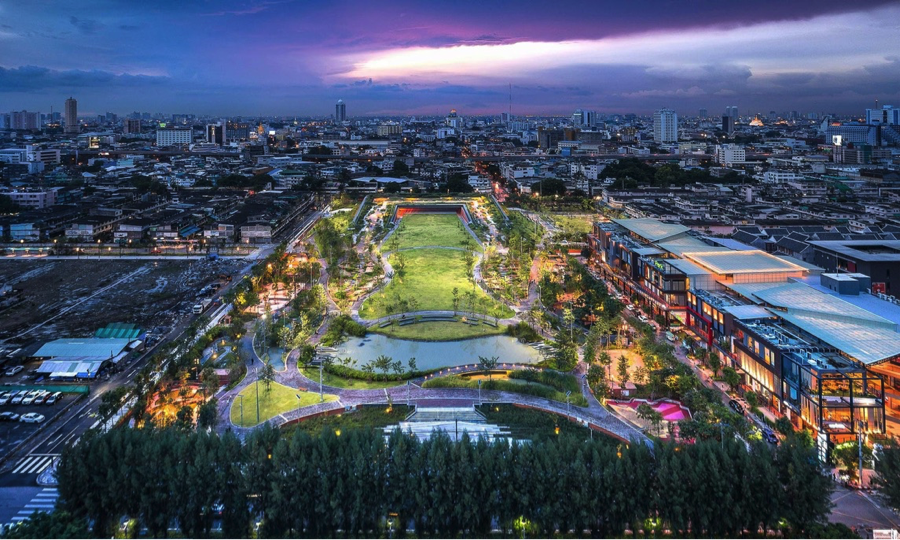
(Source: Business Insider)
Now you might be wondering how can a park help with flooding? Half of the park is on incline so that water slopes down towards that other portion of the park. The raised portion has a green roof, underneath that sits the park museum, and underneath that is the rain water tank. The water is designed to travel through artificial wetland area. The wetland area was designed to act as a filtration system. The water that has traveled through the wetland area then goes to the rain water tank. “In the case of severe flooding, the retention pond can nearly double in size by expanding onto the park’s main lawn. In total, the park can hold up to a million gallons of water (Garfield, 2018)”. The park also includes features of regular parks, including recreational areas, gardens, and trails. That is absolutely incredible. To think one park can benefit a portion of the city so much. Below is a picture of the design plans.
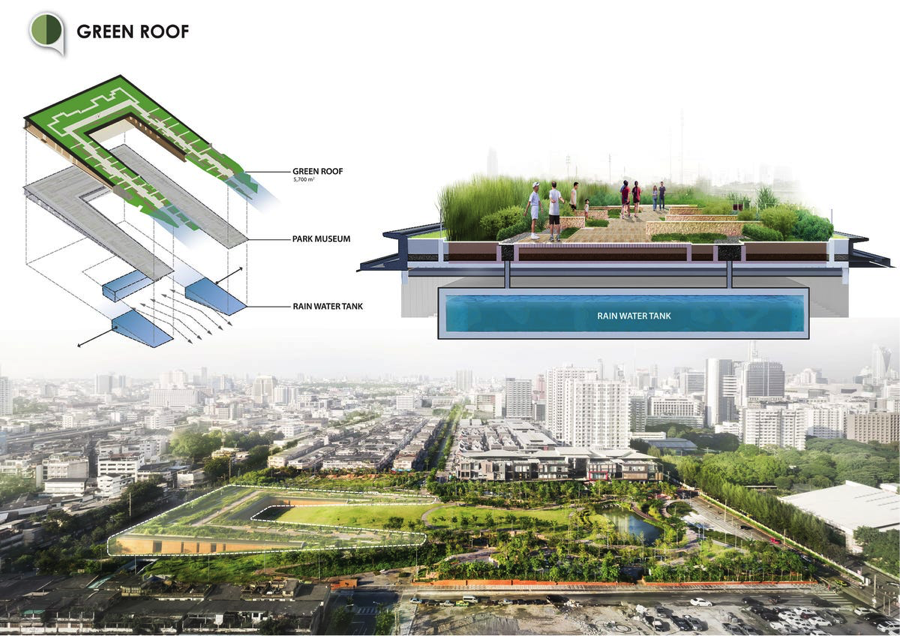
Green Roof diagram. (Source: Business Insider)
Like I mentioned before, this only helps out a small portion of Bangkok. More needs to be done to help more portions of the city. Kotchakorn Voraakhom, the chief executive and founder of Landproccess, started working on a second project; this one was located at Bangkok’s Thammasat Univeristy. “The rooftop farm at Thammasat University in Rangsit, about 40km from Bangkok’s city center, is open to anyone who wishes to grow rice, vegetables and herbs, said Prinya Thaewanarumitkul, a vice vector at the university (Bangkok Post)”. The park open in December of 2019 and it is absolutely incredible. The fact that anyone can just go in and start growing produce and rice is amazing. Also, looking at the design of the park is amazing too. This park is considered Asia’s largest urban rooftop farm. Just look at the picture of the park below.
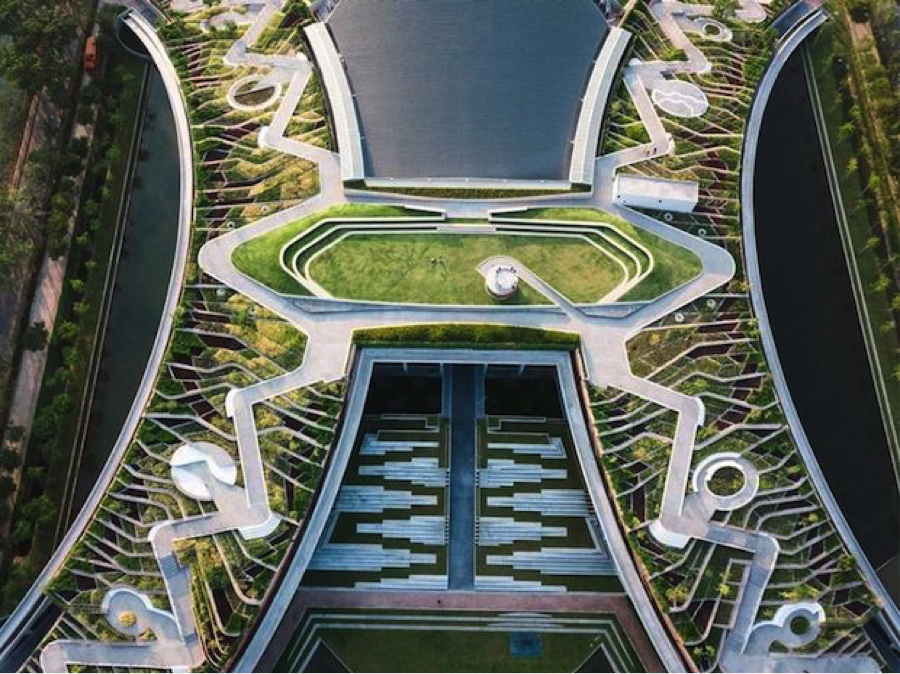
Thammasat University Park (Source: Bangkok Post)
Kotchakorn Voraakhom seems to be a real genius when it comes to designing effective climate solutions. More cities like Bangkok should be looking into implementing her designs to help this cities combat climate change. The more we start working on to prevent this now hopefully means the less the impact climate change will have on the cities.
References:
Bangkok Post Public Company Limited. (n.d.). Sinking Cities. Retrieved from https://www.bangkokpost.com/world/1740904/sinking-cities
Bangkok Post Public Company Limited. (n.d.). Thammasat sprouts Asia’s biggest rooftop farm. Retrieved from https://www.bangkokpost.com/thailand/general/1812764/thammasatsprouts-asias-biggest-rooftop-farm
Garfield, L. (2018, August 1). Bangkok is sinking, so it built a park that holds a million gallons of rainwater to help prevent flooding. Retrieved from https://www.businessinsider.com/bangkok-park-holds-a-million-gallons-of rainwater-to-prevent-flooding-2018-7
 Group 3 Colloquium