Masking Waste

By Dominique Gilbert, Christina Gold, Zachary Greening, Noa Hechtman, Jacob Wolfe

As everyone is aware, COVID-19 has caused a lot of changes to occur. Not only in a personal aspect with the cancellation of birthday parties and schools but in social and economic ways that will affect everyone globally for months, even years to come. Some discussions being brought up because of this pandemic are topics that a lot of citizens are have been having in the recent months concerning healthcare for all, the cancellation of college debt, and the implementation of livable wages. However, another conversation topic is starting to become more popular as the pandemic continues to grow, and the public’s fear continues. That topic is the improper disposing of latex gloves and disposable masks.

With news outlets, doctors, and disease officials from the CDC and WHO proclaiming their belief of everyone wearing gloves and masks outside of their homes, it is only logical to think that the public will follow. Fortunately, many people have as the wearing of gloves and masks in public has become a regular sight to see when one is doing an essential grocery trip run. However, what is also becoming a common trend to see are disinfecting wipes and latex gloves being thrown out of people’s cars. My social media feed is currently being flooded with pictures of people picking up masks from rivers, finding them at ATMs, and in parking lots of grocery markets. It’s a jarring sight to see, especially in empty streets with everyone sheltering at home when they can.

The proper use of gloves and masks has been cited to be an effective way to combat the spread of germs, as well as reduce the spread of the coronavirus. The use of the gloves is not the issue, it is how they are being disposed of. Or should I say, how they are not being disposed of. Many people are worried about bringing germs into their cars or even their houses once they have finished shopping. With fear often overrunning logic, many people are tossing their gloves and masks as soon as they get in the car. Some people are even throwing those items onto the sidewalk as soon as they exit the store. These actions are making it difficult for people who are considered essential workers and have to pick up more trash from people. Additionally, is also causing damage to our environment.

These masks and gloves do not simply stay in the same place in which one drops them. No, they are carried away by rain, wind, or a passing car and eventually end up in our waters. This can result in an increase in sea animals who die because of waste consumption. Oftentimes, sea turtles, sharks, and other creatures believe that the human waste found in the sea is food and mistakenly try to eat it. As we have all seen pictures of sea animals being harmed by human waste, as well as the damage our waste has done to the environment, I’m sure that everyone wants to do their part to ensure that that doesn’t increase during this already trying time. This is why I am doing my part by making people more aware of their actions and informing them of proper disposal methods with this blog post.

Recently, there have been environmental activists and waste management workers coming out and putting attention to the increase in waste. CNN, a popular news outlet, recently reported that waste management workers have had an increased workload since cities across the nation have gone onto lockdown, or placed stay at home orders for their citizens. Waste management workers are considered essential workers, so they have the benefit of still being paid during this pandemic the world is currently going through. Unfortunately, they are also putting themselves at risk by working with others and handling dangerous waste material. They are combatting this by increasing health measures with fog disinfectants for their trucks, masks, and heavy-duty gloves for their workers. However, this does not combat the extra workload they now have.

People have been mistakenly placing latex gloves in recycling bins. Because they cannot be recycled, these waste management workers have to pull apart the gloves and place them in their proper place, which isn’t in their recycling unit. Latex gloves are, unfortunately, not recyclable. The material that they are made of make it so that they cannot be recycled. Nitrile gloves, on the other hand, can be recycled. However, many people do not know which material the gloves they are wearing are, so they simply assume that all disposable gloves are made the same and that they can all be recycled. This is the dilemma waste management workers are trying to overcome as they continue to see an influx of gloves at their recycling units. This can also bring health risks to the waste management workers as they are being exposed to the germs that these gloves carry.

If you are thinking of buying another box of gloves for yourself and your family, then consider buying nitrile gloves. They still have the benefit of being a protective barrier between you and anything that your hands may come in contact with while you are out and about. However, this type of gloves has the added benefit of being recyclable. There has yet to be a confirmation of whether reusable gloves provide the same protection as disposable gloves, so for your safety and those around you, it is best to use disposable ones. Unfortunately, PPE (Personal protective equipment) such as masks, cannot be recycled. It is best to simply throw them in the regular trash bin for them to be properly disposed of.

This pandemic is bringing out the worst and best of everyone. Placing gloves and masks in their proper places goes hand in hand with social distancing. The more trash there are littering supermarkets, the more time essential workers have to be outside and exposed to potential contaminants. Furthermore, incorrectly placing latex gloves in the recycling bin means more work for those who work at recycling plants. So, for the sake of these essential workers, and everyone around you, please place our gloves and masks in the proper waste bin once you are done with them.
The Sinking Cities

 By Dominique Gilbert, Christina Gold, Zachary Greening, Noa Hechtman, Jacob Wolfe

CREATOR: gd-jpeg v1.0 (using IJG JPEG v80), quality = 100

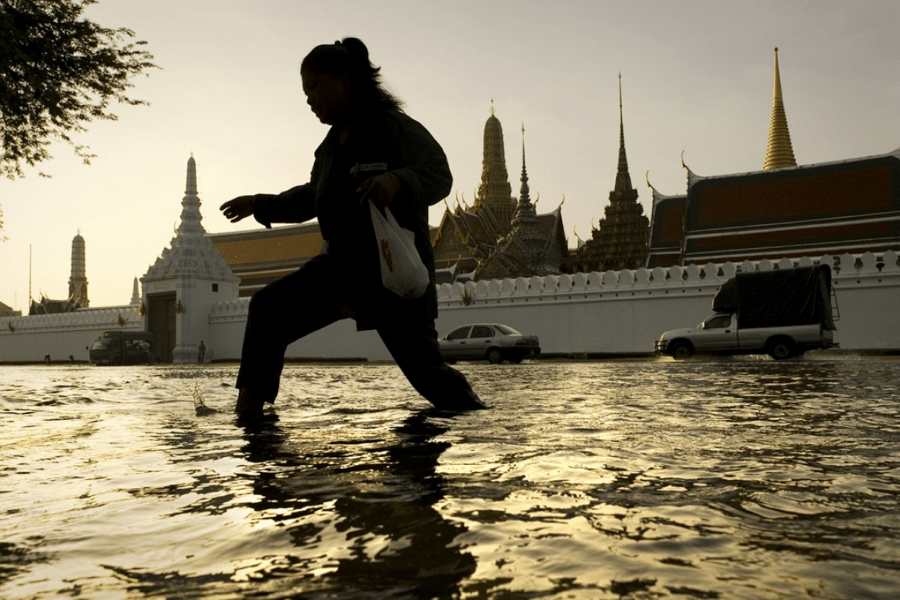
Flooding in Bangkok (Source: South China Morning Post) 

When I first heard about the sinking cities it was from one of the servers I work with. She is originally from Bangkok, the capital of Thailand. Bangkok is just one of the many urban areas in the world that has been affected by climate change.  “As temperatures rise, abnormal weather patterns – like more powerful cyclones, erratic rainfall, and intense droughts and floods – are predicted to worsen over time, adding pressure on governments tasked with bringing the 2015 Paris climate treaty to life (South China Morning Post)”.  She told me that they are considering moving the capital to a different city due to all the smog, overcrowding, and the fact that the city is sinking. I could not believe that a country could move its capital. Think of all the businesses that would have to move. Think about all the people who work at the capital. They would either have to commute to the new capital, wherever that ended up being, or move to the new capital. If they moved to the new capital location, think about their families. Their families would relocate with them. They would have to uproot their entire life. Their family members would have to get new jobs or transfer to a different location if possible. They would also have to figure their housing situation. Think about all the culture that will be lost. I could not image having to go through all that. I looked into the issue more and realized why the government would even suggest moving the capital, Bangkok.

Bangkok is another one of the cities that has been affected. Bangkok was originally built 5 feet above sea level on what was once-marshy land full with mangroves.  Now Bangkok has eroding shorelines, the weight of countless skyscrapers, and no natural drainage system. Where canals once were now lays roadways. The mangroves are practically non existent now due to the take over of aquaculture development. Mangroves are nature’s way of preventing erosion and reducing storm surge. “Seas in the nearby Gulf of Thailand are rising by four millimeters a year, above the global average (South China Morning Post)”. Basically, the weight of the city is causing Bangkok to be pushed down do to the overpopulation and the weight the skyscrapers. At the same time, due to climate change, the sea level is rising; predictions are showing that a lot of South Asia will be under water in less than 15 years. Also, due to climate change, storms are strong and producing heavier rainfall which is another thing contributing to the city’s flooding issues. Bangkok and many other cities are racing against the clock to prevent this from happening or at least try to slow down the rate in which it will inevitably happen. 

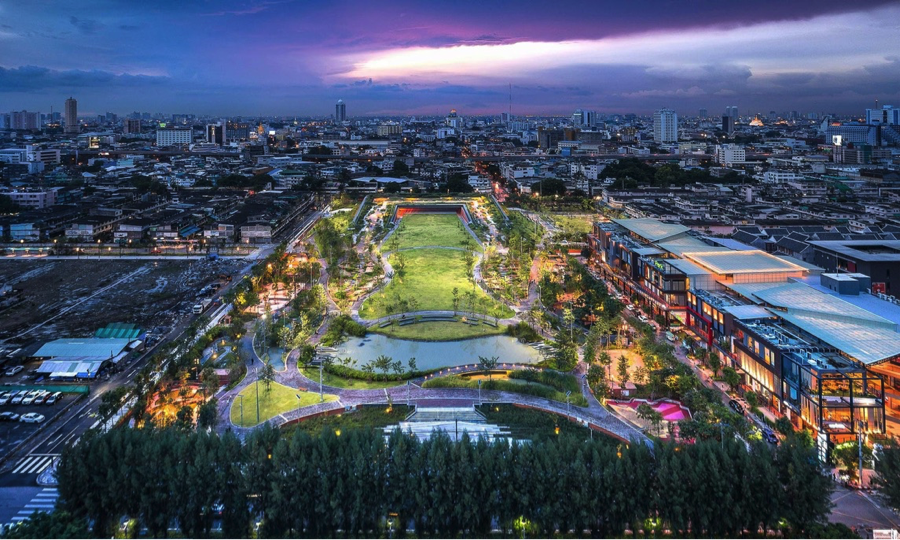
Bangkok city officials and local organizations are looking into different ways to help reduce the impact of the flooding. One of the bigger projects they did was a park, the Chulalongkorn University Centenary Park. My first thought was wow a park? What is a park suppose to do?  Well the park that they built can do a lot apparently.  The park is an 11 acre green space that holds up to a million gallons of rainwater, which would elevate some of the flooding in the surrounding area.  This park sits on the Chulalongkorn University property. Landprocess was the company that designed the plans and the Chulalongkorn University was the one to commission the project. According to the Business Insider article, the Chulalongkorn Park was built on $700 million worth of land near central Bangkok in 2017. That is a lot of land and money to put into a park but if this park works correctly it could help a portion of the city out tremendously. Not only is the park huge but it is also very beautiful Below is a picture of this beautiful park. 

Description: Macintosh HD:Users:christinagold:Pictures:Photos Library.photoslibrary:resources:proxies:derivatives:09:00:9db:UNADJUSTEDNONRAW_thumb_9db.jpg

(Source: Business Insider)

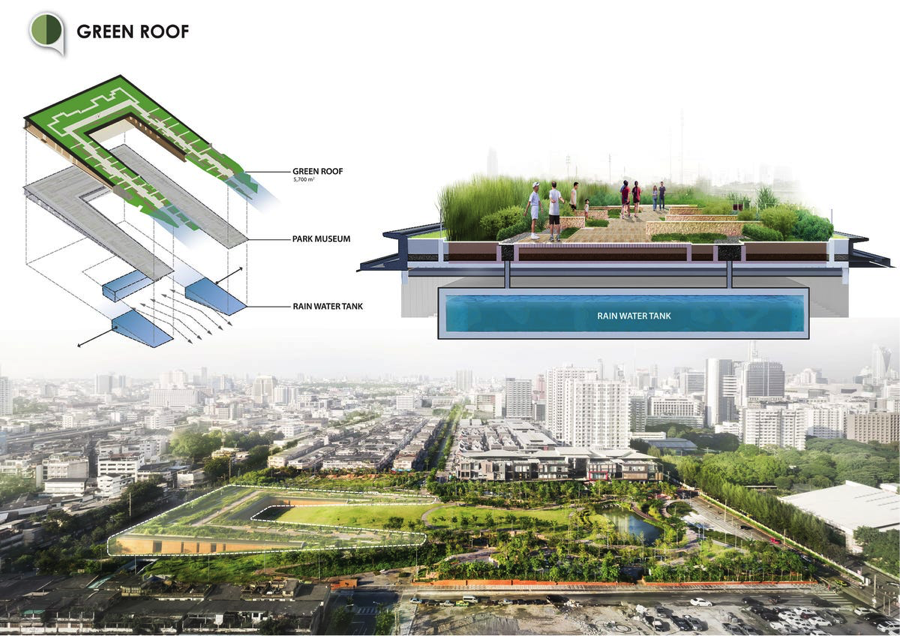
            Now you might be wondering how can a park help with flooding? Half of the park is on incline so that water slopes down towards that other portion of the park. The raised portion has a green roof, underneath that sits the park museum, and underneath that is the rain water tank. The water is designed to travel through artificial wetland area. The wetland area was designed to act as a filtration system. The water that has traveled through the wetland area then goes to the rain water tank. “In the case of severe flooding, the retention pond can nearly double in size by expanding onto the park’s main lawn. In total, the park can hold up to a million gallons of water (Garfield, 2018)”.  The park also includes features of regular parks, including recreational areas, gardens, and trails. That is absolutely incredible. To think one park can benefit a portion of the city so much. Below is a picture of the design plans. 

Green Roof diagram. (Source: Business Insider)

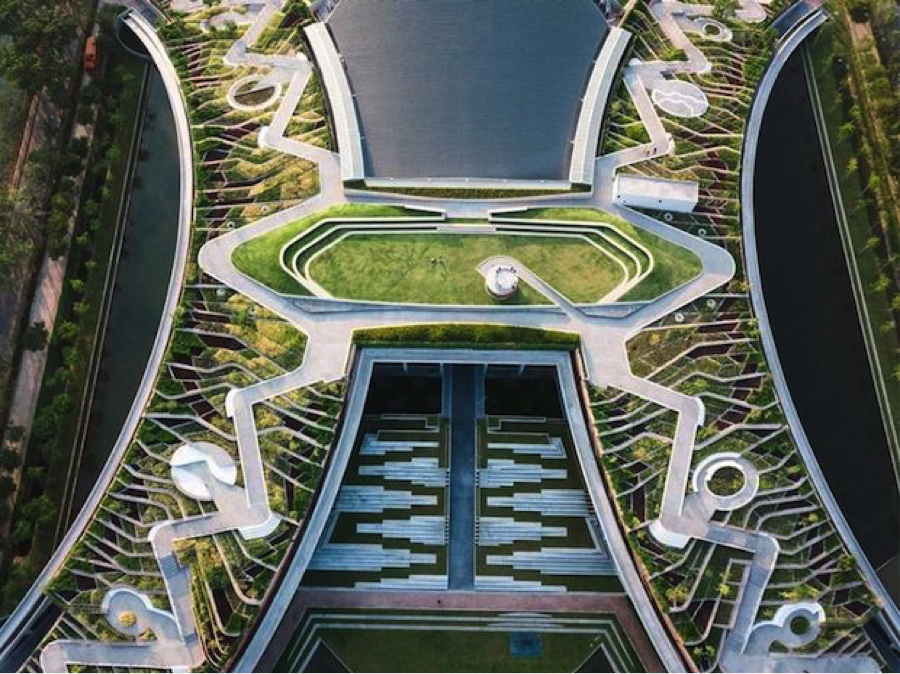
            Like I mentioned before, this only helps out a small portion of Bangkok. More needs to be done to help more portions of the city. Kotchakorn Voraakhom, the chief executive and founder of Landproccess, started working on a second project; this one was located at Bangkok’s Thammasat Univeristy.  “The rooftop farm at Thammasat University in Rangsit, about 40km from Bangkok’s city center, is open to anyone who wishes to grow rice, vegetables and herbs, said Prinya Thaewanarumitkul, a vice vector at the university (Bangkok Post)”.  The park open in December of 2019 and it is absolutely incredible. The fact that anyone can just go in and start growing produce and rice is amazing. Also, looking at the design of the park is amazing too.  This park is considered Asia’s largest urban rooftop farm. Just look at the picture of the park below.

Thammasat University Park (Source: Bangkok Post)

Kotchakorn Voraakhom seems to be a real genius when it comes to designing effective climate solutions. More cities like Bangkok should be looking into implementing her designs to help this cities combat climate change. The more we start working on to prevent this now hopefully means the less the impact climate change will have on the cities. 

References: 

Bangkok Post Public Company Limited. (n.d.). Sinking Cities. Retrieved from   https://www.bangkokpost.com/world/1740904/sinking-cities

Bangkok Post Public Company Limited. (n.d.). Thammasat sprouts Asia’s biggest rooftop farm. Retrieved from  https://www.bangkokpost.com/thailand/general/1812764/thammasatsprouts-asias-biggest-rooftop-farm

Garfield, L. (2018, August 1). Bangkok is sinking, so it built a park that holds a million gallons of rainwater to help prevent flooding. Retrieved from          https://www.businessinsider.com/bangkok-park-holds-a-million-gallons-of   rainwater-to-prevent-flooding-2018-7

Food for our Future: The Importance of Sustainable Food Production and Consumption

  By Dominique Gilbert, Christina Gold, Zachary Greening, Noa Hechtman, Jacob Wolfe   

Sustainability is avoidance of the depletion of natural resources over time in order to maintain an ecological balance. Essentially, it’s making sure that the natural resources we have now are available for our future generations. One of the most essential things we need to do is to have our food production and our consumption be more sustainable, so to speak, Genetically Modified Organisms (GMOs), insecticides, and factory farming which continuously take a toll on the environment and can prevent us from giving our children and their children the opportunity to have the same food resources.

According to the University of Michigan’s Center for Sustainable Systems, nutrient runoff from the upper agricultural regions of the Mississippi River creates a hypoxic “dead zone” in the Gulf of Mexico. In 2017, the hypoxic dead zone was the largest measured since 1985, at 8,776 square miles. The agricultural runoff polluting the Mississippi River and the Gulf of Mexico can be anything from pesticides being sprayed on plants to keep bugs from eating them, to animal waste like manure. This runoff waste pollutes our environment and would make it more difficult for future generations to produce their own food and it would cause them to continue to destroy the environment because of inherited agricultural practices. We are setting a dangerous precedent.

A potential solution to the pollution caused by agricultural runoff is to buy and eat organic. According to the Center for Sustainable Systems, organic farms don’t use chemicals that require lots of energy to produce, pollute soil and water, and present human health impacts. Sales of organic foods were 6.4 percent higher in 2017 than in 2016, and organic food accounts for 5.5 percent of all food sales in the U.S.

The production and consumption of organic foods won’t entirely stop the production of foods that are genetically modified or sprayed with pesticides, but it can slow them down and make the industry think twice about unsustainable farming practices. It’s also important to know your “dirty dozen” foods as a consumer buying groceries at your local market. The Environmental Working Group’s 2019 list of the dirty dozen includes strawberries, spinach, kale, nectarines, apples, grapes, peaches, cherries, pears, tomatoes, celery, and potatoes. Be aware of these, buy them organically, and wash them thoroughly before consumption.


Some people even choose to go on a vegan diet because the amount of energy and water needed to produce one serving of beef is significantly higher than that of vegetables. According to the same study, one serving of beef is more associated with greenhouse gas emissions than 20 servings of vegetables. 20 percent of Americans cause half of the food- related greenhouse gas related emissions, and a diet shifted away from meat could reduce this up to 73 percent.

Going on an entirely plant- based diet reduces the total meat consumption and contributes to the reduction of the production of greenhouse gases. However, this is not a perfect or entire solution because of pesticides and agricultural runoff that ends up in the Mississippi River and the Gulf of Mexico, as discussed earlier. It is very difficult to find sustainable and “perfect” alternatives to our flawed food production and consumption habits, but if we can find ways to reduce our waste and emissions, we can slow our environmental destruction down for future generations.         

     Another major waste problem unsustainable food production can cause is plastic waste. This isn’t something most people think of off the top of their head. When you go to the grocery store, how often do you see fruits and vegetables packaged or wrapped in plastic? Or meats on Styrofoam trays and wrapped in plastic? Or the plastic bags people put their produce in to hold it before buying it? Those all contribute to our carbon footprint because of the sheer amount of plastic waste we produce. 

Fruits have peels for a reason, to protect them from the outside elements. Instead of buying apples in a plastic 6- pack holder, bring a reusable produce bag and transport your fruits and vegetables that way. Some potatoes come individually wrapped in plastic, even though they grow in the ground. They are already dirty! Before cooking with your potatoes, wash them thoroughly with water to get the dirt off before peeling. Avoid buying individually wrapped potatoes.

As for buying meats, it’s hard to avoid buying meats on the Styrofoam trays wrapped in plastic. Instead, you can buy meat at the meat or deli counter of some grocery stores like The Fresh Market. That meat will come wrapped in sustainable, recyclable paper instead of wasteful plastics.  When it comes to our role as food consumers, small and subtle choices can create a big and more sustainable difference.

In conclusion, we will struggle to set our future generations up for success and give them sustainable ways to produce and consume food if we as the current generation don’t change our practices to make them more sustainable. Sustainable food production and consumption is essential to making sure we have natural and food resources for future generations. If we can make these changes, big and small, we can set ourselves and our future generations up for success.

Suck It Up

 By Dominique Gilbert, Christina Gold, Zachary Greening, Noa Hechtman, Jacob Wolfe

It’s getting more popular than ever for one to use reusable straws. With the increasing concern with climate change and the increasing impact of pollution, sustainable living has seen a surge in popularity. If you don’t know, sustainable living is a lifestyle where an individual chooses to integrate products that are reusable/ eco-friendly and uses techniques that reduces wastefulness and resources used to complete everyday tasks. 

The transition from plastic straws to reusable straws is one of the easiest (and thus most popular) ways in which people have integrated reusable and sustainable habits into their lives. Plastic straws, a tool first created to aid disabled people with consuming liquids, it has now become ingrained into American society for plastic straws to be readily available at eateries and grocery stores for everyone to use. 

One might ask, what’s the harm of using plastic straws? Well, not much if it was just a singular straw, however, that is not the case. In 2018, USA Today reported that more than 500 million plastic straws were used every day in the United States. 

In this case (which is our reality), there is a lot of harm with plastic straws. Many of us have seen the viral videos of sea turtles with straws up their nose. It is a gut wrenching sight to see an innocent animal crying in pain because of the pollution we have caused. Though a relatively low percentage in the overall large scale of pollution in the United States, it is still a problem that has caused harm to our environment and organisms. 

As previously stated, using reusable straws is the easiest way to integrate sustainability into one’s lifestyle. They allow people to still be able to easily sip their drink while avoiding the guilt of contributing to America’s evergrowing plastic waste. I have had the privilege of trying a few different types of reusable straws from metal, paper, to even silicone ones. My college, Florida Gulf Coast University, has had a large play in that. Going to an environmentally conscious institution, they are always looking for ways to get students the tools needed to jumpstart a sustainable lifestyle. Some of those ways have been handing out metal and silicone straw kits at events. 

From the straws that I have tried, I currently don’t have a definitive favorite. I like to say, finding the perfect reusable straw is like finding the perfect pen and unfortunately, I haven’t found my favorite pen yet. Like anything else you try, it has its pros and its cons. Some straws (personally), have more cons than others, while others (personally), have more pros than others. 

I know that there are a lot of people who have not yet tried reusable straws either because they can’t, or because they are afraid to waste their money on something they’ll end up not liking. Because of that, I’m going to go through the reusable straws that I have tried, list a brief description of it, and list the pros and cons of it. At the end of the day, you can decide which straw is right for you. 

Metal

The metal ones were the most physically appealing to me. Matching an “aesthetic” if you will, of being the quintessential sustainable person. However, even with the appealing exterior appearance and feel, it was the taste that mattered the most. After washing it (always wash your metal and silicone straws first!), I used it to drink a smoothie. It was a smoothie that I had purchased dozens of times prior so I knew how it should taste in case it was off. Turns out, I was right to do so. Combining with the cold temperature of the smoothie and the metallic aftertaste from the straw, it made for an extremely unpleasant experience. Even after rinsing out the straw again in case there was any leftover soap residue, the aftertaste still lingered.

However, I found a set of metal straws at my local Marshalls with silicone covering the tip. That straw was way better than the first straw I had! The silicone took away from any metallic aftertaste, yet still allowed for easy sipping. 

Pros:

  • Reusable
  • Easy to wash
  • Appealing look
  • Thin shape
  • Easy to purchase 

Cons:

  • Metallic aftertaste (with the straw without the silicone tip)
  • Not good with cold drinks

Paper Straws

My first experience with them came from a Starbucks in St. Petersburg, Florida. I was quite surprised to see that instead of placing a plastic one in my drink, there was a cupful of paper ones. The straws were thick (not too thick though!), easy to use, and did not alter the drinking experience compared to other reusable straws. However, with these, you are unable to reuse these. I think this is doubly true if you use the straw to drink a smoothie or any other kind of thick drink. I would say use these straws sparingly as they are lacking the reusability factor compared to the other straws. 

Pros:

  • Easy to purchase
  • Thin shape 
  • Didn’t affect taste

Cons:

  • Can’t be reused
  • Might get soggy with a large drink

Silicone Straws

These straws are ones I have seen become quickly popular. Spotted at campus events, farmers markets, and even available for free samples at some places, they seem to be cheap and easily accessible to both businesses and consumers. However, no matter the convenience, it is the usability that matters the most. Compared to plastic and metal straws, silicone straws are at least two times as wide. 

These are easy to wash and easy to transport. Unlike with metal straws, silicone straws typically are not accompanied by a straw cleaner. However, these are usually wider than metal straws so to clean them, I simply drizzle soap down one of the ends and make sure to focus on wiping down both ends of the straw. I think these work great with smoothies because it is so wide and doesn’t get affected by the coldness of the drink. 

Pros:

  • Easy to clean
  • Easy to purchase 
  • Good with cold drinks
  • Doesn’t change the taste

Cons:

  • Odd fit with most drink covers
  • Not great with hot drinks
  • Hard to get the bends out

I hope you guys found this very helpful and useful when you are trying to pick up your first reusable straw. 

Sources:

https://www.usatoday.com/story/news/2018/07/18/anti-straw-movement-based-unverified-statistic-500-million-day/750563002/

Birds- Blog Post 2

 By Dominique Gilbert, Christina Gold, Zachary Greening, Noa Hechtman, Jacob Wolfe

I have always wanted to learn more about birds. My mother told me that my grandma loved birds, and although I never got to meet my grandma, I feel especially connected to her when I see one, particularly a blue jay or a cardinal. I think this is because they are one of the “prettiest” birds, and one that I don’t commonly see which is why I admire them when I do. Sometimes I wonder what it was about birds that my grandma seemed to love so much. Was it their beauty? Was it the fact that there arewere so many species of birds? Or was it seeing them fly? I’m guessing it was all three reasons,  and maybe even more, that I may or may not ever be able to come up with.

The site, “Dictionary” states that a bird is, “Any warm-blooded vertebrate of the class Ave’s, . Having a body covered with feathers, forelimbs modified into wings, scaly legs, a beak, no teeth, and bearing young in a hard-shelled egg”.  So, which came first: the chicken or the egg? The world may never know. However, let us talk about something we do know, starting with our state bird. I remember learning in elementary school that every state has its own “state bird”. Although I wish I could say that Florida’s state bird is an eagle, specifically an FGCU eagle or even an American eagle, it is actually the Northern Mockingbird.

Thinking about it, I guess we do have some relation to the Mockingbird considering I’m pretty positive we all had to read “To Kill a Mockingbird” at some point in our academic careers. “The Mockingbird was adopted as Florida’s state bird in April of 1927, It is a songbird and also the state bird of Arkansas, Mississippi, Tennessee and Texas” (Ferguson). They are grey and white, 10 inches long, and they basically sing all throughout the year but seemingly for different reasons, each bird usually knows around 25-30 different “songs”. Some fun facts are that only the “single males” sing at night and scientists have found that female mockingbirds are attracted to males that can make the most amount of sounds.

Mockingbirds are seemingly cool and all but there are also literally 10,000 different species of birds and , likely even more than that, r. Some Researchers believe there may actually be up to 20,000 species. “The numbers that say 10,000 are based on what is known as the “biological species concept” in which they are claiming is an outdated source; it basically defines species in terms of what animals can breed together” (Zink). So, speaking of 20,000 different bird species, I was wondering what the most common birds in the world are so that we can gain a little bit of perspective. “The most common bird in the entire world is the Domestic Chicken in which there are 22.67 billion” (Nag).  The second would be the number one most common bird in the wild at 1.5 billion it is the Red-Billed Quelea, then it drops down to the millions following. The Mourning Dove, American Robin, Common Pheasant, Red-Winged Blackbird, Chipping Sparrow, Common Starling, Common Swift and Yellow-Rumped Warbler which all range between 1-5 million. Although common, they each have something unique about them.

The Domestic Chicken is not only known for the obvious: food, . But also held in high regard within the Egyptian, Zoroastrians and Roman cultures. Secondly, the Red-Billed Quelea are most commonly found in Africa.

When they fly together, they fly with many and can sometimes be mistaken for a cloud! The Mourning Dove is the most frequently hunted species in North America.  The American Robin is popular for its warm orange breast. The Common Pheasant is native to China and East Asia. What’s really cool about this bird is that it is very easy to tell which is female and which is male as the male is very vibrant and the female is grey. This is usually a similar case with a lot of birds. The vibrant colors are supposed to be used to try and impress the female. The male Red-Winged Blackbird will do anything they can to get noticed, they sit on high perches and sing all day long. The Chipping Sparrow has a black line through its eye, and the oldest Chipping Sparrow in the world was at least 10 years and 11 months old.

The Common Starling,: known to be a bit aggressive, but when taken a good look at our beautiful birds. “All the European Starlings in North America descended from 100 birds set loose in New York’s Central Park in the early 1890s. The birds were intentionally released by a group that wanted America to have all the birds that Shakespeare ever mentioned. It took several tries, but eventually, the population took off” (Cornell University). What’s really cool about these birds is that, since they’ve only been around starting insince the 1980s, there is littlesmall genetic variance but that hasn’t seemed to stop these birds from flourishing, literally. They are also great voice mimics., Iinstead of creating their own sounds they kind of just steal the ones they hear from other birds;, now that’s smart. But don’t worry Common Starlingsthey have some individual characteristics too; they are strong fliers and can get up to speeds of 48 mph even when the speed limit is 35.

The Common Swift, as of November 2016, has been the new record holder for the longest uninterrupted flight. “Scientists have found that the birds can stay up in the air for 10 months straight” (O’Donnell). Scientists seemed to have suspected that they could fly for very long periods of time but never really had the technology to be able to prove it. Then came the iPhone. and then they were also able to attach a light and an accelerometer on 13 different birds. Three of these birds did not land for 10 months.

Scientists suspect the reason they stay in the air so much is that they appear as though they are wounded and fragile when on the ground making them easy predators, so they avoid the ground as much as possible. Last on the list of the 10 most common birds is the Yellow-Rumped Warbler. Both males and females have yellow on them. Often times they feed on insects in midair, yet quickly switch over to eating berries in the fall.

Works Cited

aab_admin_user. “Online Bird Guide, Bird ID Help, Life History, Bird Sounds from Cornell.” All About Birds, Cornell University , www.allaboutbirds.org/news/.

 “Bird.” Dictionary.com, Dictionary.com, www.dictionary.com/browse/bird.

“Common Pheasant.” National Geographic, 24 Sept. 2018, www.nationalgeographic.com/animals/birds/c/common-pheasant/.

Ferguson, Joe. “Florida State Bird.” Florida State Bird: Mockingbird (Mimus Polyglottos), www.ereferencedesk.com/resources/state-bird/florida.html

Nag, Oishimaya Sen. “The Most Common Birds in the World.” WorldAtlas, 9 Mar. 2016, www.worldatlas.com/articles/most-populous-bird-species-in-the-world.html.

O’Donnell, Jenna. “The Common Swift Is the New Record Holder for Longest Uninterrupted Flight.” Audubon, 9 Nov. 2016, www.audubon.org/news/the-common-swift-new-record-holder-longest-uninterrupted-flight.

Zink, Robert, and John Klicka . “New Study Doubles the Estimate of Bird Species in the World: AMNH.” American Museum of Natural History, www.amnh.org/about/press-center/new-study-doubles-the-estimate-of-bird-species-in-the-world.

Babcock Ranch

By Dominique Gilbert Christina Gold Zachary Greening Noa Hechtman Jacob Wolfe  

Babcock Ranch, Florida, the United States’ first solar-powered city, is now entering its 15th year of existence. The city’s land, which lives on the edge of the now Babcock Ranch Preserve, was purchased in July 2005 by a company owned by former American football player Syd Kitson. Previously, the land was privately owned by the heirs of Edward Vose Babcock, a lumber industrialist who bought the land in 1914. When the Babcock family announced their intentions to sell the land, conservationists quickly pointed out the importance of this land for preservation purposes. The land makes up what was viewed by the conservationists as the final section of land needed to complete an environmental passage from Lake Okeechobee to the Charlotte Harbor Estuary. A deal with the State of Florida for purchase of the land was in its final stages with a price set at $455 million. However, because the family wished to sell the land via all the company’s stock in order to avoid a heavy tax burden, negotiations with the State directly broke down as the Florida Constitution prohibits using funds earmarked for land purchase to buy company stock. 

The real estate development company Kitson & Partners ended up purchasing the land for far more money. The company eventually sold most of the land, which was the most environmentally critical, to the State of Florida and Lee County, maintaining just 18,000 acres of the original 91,000 for development. These 18,000 acres is the beginning of Babcock Ranch. 

Babcock Ranch construction started in 2006 and has maintained eight core initiatives throughout its now 14-year development. These initiatives are environment, health, education, energy, technology, transportation, storm safety, and fun. Balancing these is of course no small feat, but the recent trip of the authors leaves a good impression of their success so far.  

The authors had minimal prior knowledge of the design planning of Babcock Ranch. However, it is readily apparent that much careful planning was involved. Starting with energy, Florida Power & Lighting has now begun construction of an on-site 75-megawatt solar plant. This power plant, along with rooftop solar panels on some of the housing and other buildings, is designed to provide more power than the future 19,500 homes will consume. By providing entirely solar energy, the city’s carbon footprint is significantly reduced, lending to the environmental and health initiatives.  

Considering the transportation and technology initiatives, the city is laid out so that major destinations will be, at most, within biking distance. This includes major business districts, schools and parks. There are eight schools planned, with elementary ones near the center of each village and a high school accessible via bike trails. This attests to the careful planning as children can be accompanied short distances by their parents to school while teens will be able to get more exercise and freedom by biking to school. An offer has even been extended to the Florida Gulf Coast University for the creation of a satellite campus within the Babcock community. 

The city also plays host to an experimental transportation technology. Shuttles have been designed with the intention of eventually offering a completely autonomous electrical transportation service that can be subscribed to in a manner like Uber or Lyft. It is envisioned that these vehicles will have no driver and simply will react to a call by an app, pick up the caller, deliver them to their destination, then continue about its business and maintenance. 

In order to promote storm safety, the city is designed with several lakes. In the event of major storms, these lakes help prevent the elevated levels of water from causing as much damage as it otherwise would. These lakes also serve as sources of recreation as well as transportation with people being able to take a boat from one area to another. 

All these features play a role in the environment. A sustainable energy source and promotion of other methods of transportation besides cars are always enticing to hear about. In fact, all the buildings in the area are certified for maintaining a high energy efficiency. These are all great theoretically, but it is important to not forget, the land where all of this is built was unoccupied. All these “great for the environment” features are being built ON the environment. 

This is not to take away from these initiatives. Babcock Ranch itself was built on agricultural land. So it was not entirely natural to begin with, but still it is worth mentioning that now, the environment will not have a chance to recover on its own like it would otherwise. These technologies and features designed to help the environment would be better for the environment if they did not reduce the size of the natural environment.  

If the argument is that humans need to expand, then this is not a bad venture. Babcock Ranch has dedicated to conservation approximately 90% of its initial size including more than half the part retained by the developing company. It will be 100% solar powered, and minimally dependent on cars. As a result, it has completely taken care of the two largest carbon-producing activities of humans, a very impressive feat. Its lakes, along with its overall design, promote exercise and other outdoor activities. It certainly has followed its guiding initiatives of environment, health, education, energy, technology, transportation, storm safety, and fun. 

Now the question is, how can we apply what we have learned from the still young development of Babcock Ranch? Well, let’s consider energy. According to government statistics, Florida is the fourth largest energy consuming state. It uses nearly 8 times the amount of energy it produces. In 2008, Florida burned approximately 29 million tons of coal. In 2018, the number has fallen to 12 million, with natural-gas plants replacing the old coal ones. Also, in 2018, solar energy accounted for more than a third of renewable energy. What if every building in Florida had its own solar panels like Babcock? 

Transportation poses more of a problem. It simply isn’t feasible to re-layout major cities just to promote not traveling by car. Instead, the government and people need to organize a plan for more centralized or other alternatives to transportation. In very recent history, several companies like Boeing have started demoing personal helicopter-like devices for travel. While this sounds like a step in the wrong direction in terms of energy consumption, think about the fact that it won’t require any roads to use. The video here talks about the hope that roads, built in the 1900s, are getting congested enough that people are feeling the need to do something about it. The people in the video also mention that transportation is now the leading cause of carbon emission. But they are optimistic, saying that once one device like theirs can transport humans, many more devices of all different shapes and sizes will start being invented. Henry Ford said, “If I asked the people what they want, they would have said ‘faster horses.” No one knows how this will turn out, but it is something to keep an eye on. 

It is important that our generation does as much as possible to improve our sustainability. A recent study warns that we may very well be reaching a point of no return in environmental change. Sure, they could be wrong, but just think for a second. What if they are not? Building sustainable cities of tomorrow is nice, but we need to apply these practices to our fuel-centric cities of today. Before it is too late. 

Image result for babcock ranch
Entrance
Image result for babcock ranch
Restaurants
Image result for babcock ranch
Park
Image result for babcock ranch
Home

Design a site like this with WordPress.com
Get started